
New Texas Texting Guidelines
Texas SB 140 Compliance for Diamond Marketing Subscribers (Updated for Fall 2025)
Disclaimer: This post is for educational purposes only and should not be considered legal advice. Always consult with your legal counsel to understand how Texas Senate Bill 140 (SB 140) and related laws apply to your business.

Texas recently passed Senate Bill 140 (SB 140), which significantly changes how text marketing can be used with Texas residents. If you have contacts in Texas, this law directly affects you.
Read the full law here: Texas SB 140 PDF
Quick Refresher on SB 140
Texas SB 140 expanded the state’s telemarketing rules to cover texts, MMS, and voice messages to Texas residents. It took effect September 1, 2025 and introduced potential requirements to register with the Texas Secretary of State, pay a $200 annual fee, post a $10,000 bond, and file quarterly reports for certain messaging programs.
When this law took effect, we recommended preparing as if those requirements could apply broadly. Since then, there have been important developments.
The Legal Challenge (What’s Happening in Court)
On September 1, 2025, Flux Footwear, Postscript, and the Ecommerce Innovation Alliance filed a federal lawsuit challenging parts of SB 140.
They argue they only message opt-in recipients and that SB 140 treats consent-based programs like spam, with vague terms (e.g., who counts as a “customer,” area codes vs. physical presence) that make compliance unclear. A hearing is scheduled for November 2025.
What the State Told the Court (Why This Matters to You)
Recent state filings provide helpful signals for compliance-minded senders:
The law targets unwanted/deceptive texts — not consented or expected ones. If your recipients opted in, the state said SB 140 “is not aimed at you.”
Consent is the bright line. Messages sent with permission are less likely to trigger “telephone solicitation” rules (registration/bonding).
Registration enforcement appears limited. The Secretary of State indicated it will not investigate/enforce SB 140 violations; the Attorney General’s enforcement is discretionary and focused on deceptive/fraudulent behavior.
“Customer” exemption may apply. Businesses messaging current or former customers using the same name for 2+ years may be exempt from registration. “Customer” isn’t tightly defined and may include opted-in subscribers, not just purchasers (your attorney should confirm).
Bottom line right now: If you send clearly consented texts and keep records, you are likely not the target of SB 140 enforcement. The law still exists, but active registration enforcement appears limited as of today.ir own attorney to determine whether they need to register under SB 140.
What This Means for Diamond Marketing Subscribers
1) Opt-In Required (and Documented)
Continue to collect explicit, documented opt-in for anyone who is not personally enrolled with you.
Keep proof: who opted in, when, how, and to what (e.g., “weekly tips,” “class reminders”).
Send only what you promised (content + frequency).
2) Old “Blast” Lists Are Out
Do not mass-text legacy lists without consent.
Even with consent, avoid broad, generic “sales blasts.” Use targeted, expectation-aligned messages.
3) Registration & Bond (Should You Do It?)
As written, SB 140 includes registration/bonding for certain telemarketing activity.
As practiced right now, the state has told the court it’s not actively enforcing registration and is focused on deceptive, non-consensual behavior.
If your program is fully opt-in or you may qualify under a “customer” exemption, your attorney may advise that registration/bonding does not apply.
Action: Ask your attorney whether your specific program fits an exemption or falls outside the registration trigger given your consent model.
4) Keep Complying Like a Pro (regardless of the lawsuit)
Maintain clean opt-in/opt-out flows.
Honor STOP and PASS immediately. (This is done automatically for you)
Respect quiet hours. (Do not text throughout the night)
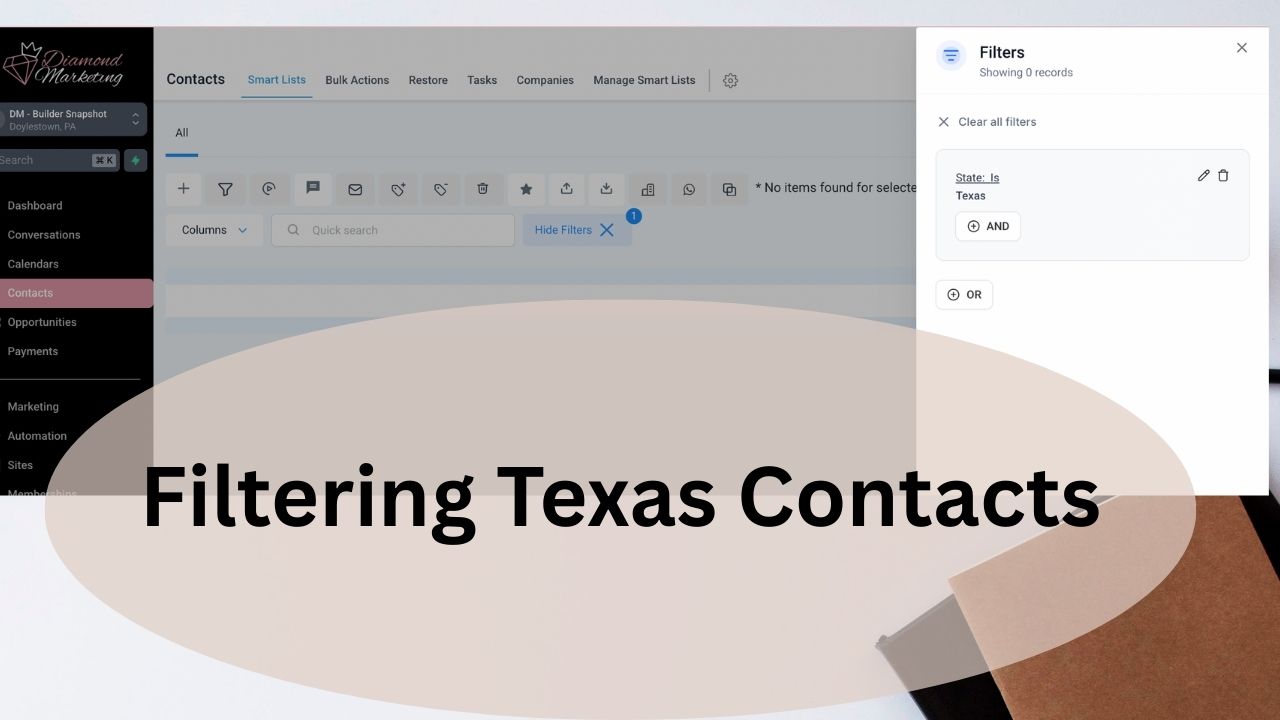
Diamond Marketing: How to Tag & Filter Texas Contacts (Step-by-Step)
Contacts → More Filters → State/Province = Texas (TX) → Apply.
Select All → Add Tag:
Texas SB140 – Review/Do Not Text(use whatever naming fits your system).Save as Smart List so new Texas contacts auto-flow into this view.
In your opt-in forms and CTAs, make sure subscribers see clear expectations (what you’ll send, how often).
Recommendations
Transition fully to opt-in compliant texting.
Focus on personalized, relationship-based communication rather than mass blasts.
Build opt-in lists using the Grow Your List Course (8 modules).
Decide with your attorney whether your business needs to register under SB 140.
Stay tuned for updates as we navigate specifically how this will effect Diamond Marketers
Texas SB 140 FAQs (Updated)
Do I need to register with the State of Texas right now?
Registration is still in the statute, but the state has indicated it’s not actively enforcing it. If you only message opt-in recipients, the state’s position suggests registration may not apply to you. Ask your attorney for a program-specific call.
What about the $10,000 bond?
That bond is tied to the telemarketing registration framework. If you qualify for a “customer” exemption or operate a consent-only program, your attorney may advise that a bond is not required at this time.
When will the court decide?
A federal hearing is scheduled for November 2025. A ruling later this fall could pause or clarify how SB 140 applies to consent-based programs.
What should I do right now?
Keep your house in order: documented opt-ins, instant opt-outs, quiet hours, accurate records, and expectation-aligned sends. Tag Texas contacts and use Smart Lists to control distribution.
Texas SB 140 Compliance Checklist
Disclaimer: This checklist is industry guidance only and not legal advice. Consult your attorney for registration or compliance questions.
This is good news for legitimate senders. Texas told a federal court SB 140 is not meant to punish businesses sending messages people asked to receive. Until the court rules, the smartest path is the one you’re already on: stay calm, stay compliant, keep consent first, and document everything.